For most of software history, legacy code was a paradox: perfectly functional yet tragically trapped in the past.
Not because it did not work. Quite the opposite. It often worked perfectly. COBOL systems still clear transactions. VB6 applications still run factories. Legacy Java apps still underpin governments. Execution was never the issue. The problem was understanding what the code truly meant.
Converting a large codebase from one language or version to another used to be an act of endurance. It required teams of engineers to first understand what the system actually did, then rewrite it line by line into a modern equivalent. The risk was not syntax. It was semantics. Every migration was a fragile negotiation with decades of embedded assumptions.
That negotiation was slow, expensive, and cognitively brutal. Most organizations chose inertia. They wrapped legacy systems in APIs. They built façades. They added another layer. Complexity was preserved, not resolved. The cognitive wall grew higher.
The Cost of Understanding
When we talk about legacy conversion, we are really talking about comprehension. A mature enterprise codebase is not just logic. It is history, policy, workarounds, domain knowledge, and human habit encoded over years. Before AI, translating that into a new stack required engineers to hold enormous mental models in their heads.
Let me frame it like this. No single human can truly comprehend a 500,000-line system end to end. Even teams struggle. Context leaks. Assumptions drift. Knowledge walks out the door. This is the Cognitive Wall. The point at which system complexity exceeds human cognitive bandwidth. Language migration projects often failed not because engineers lacked skill, but because comprehension itself was the bottleneck.
AI as a Semantic Bridge
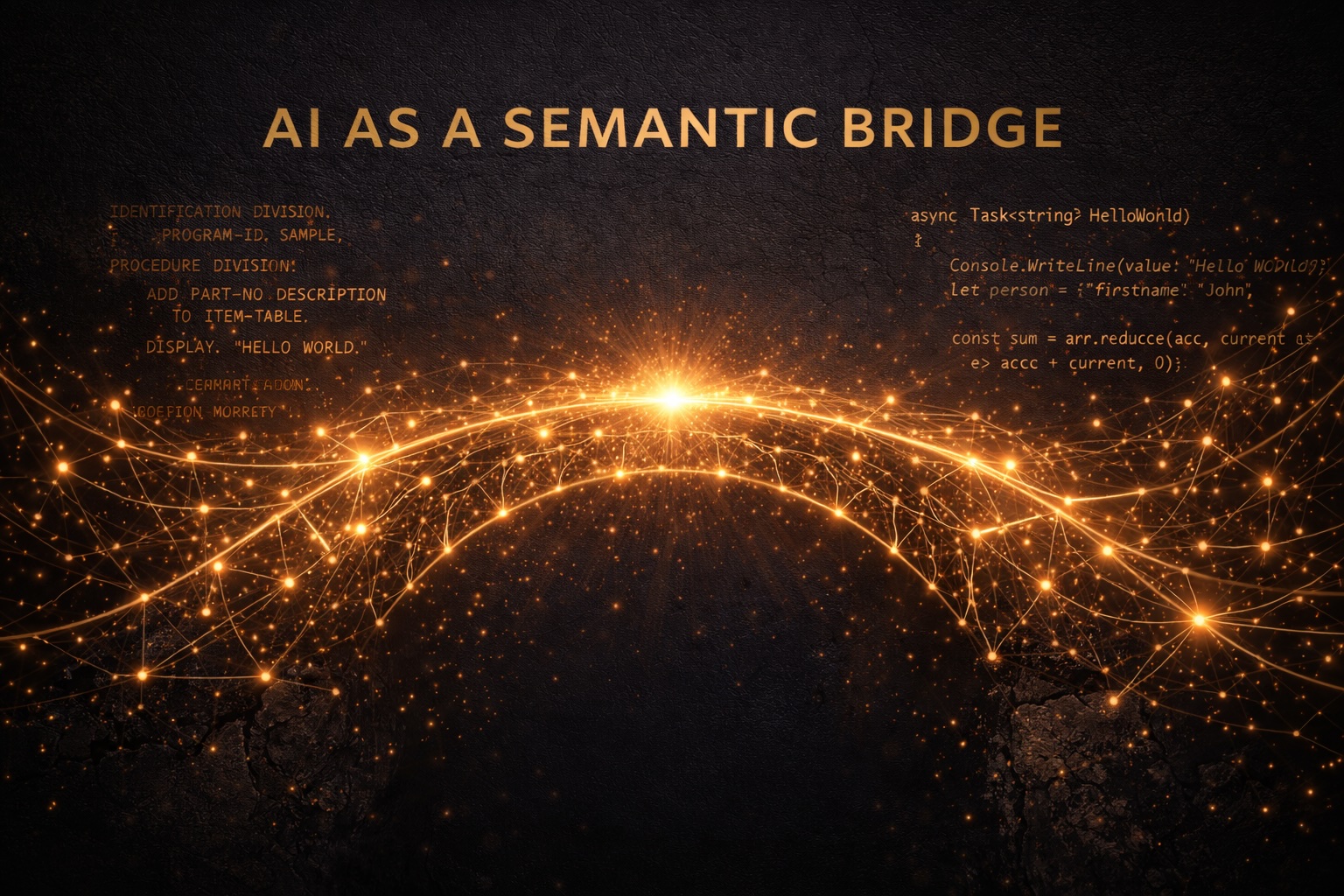
AI transforms the equation by focusing on intent, not just syntax. It deciphers the meaning behind the code. Modern large language models can ingest an entire codebase, infer patterns, detect architectural conventions, and reason about functional equivalence across languages. They do not just replace for loops with foreach. They understand what the loop is doing.
This is the breakthrough. Conversion becomes transformation rather than transcription. You can ask an AI system to:
- Convert a legacy COBOL module into modern Java or C#
- Upgrade a monolithic .NET Framework app to .NET 10+
- Refactor synchronous code into async patterns
- Translate infrastructure scripts into Terraform
- Modernize a front-end from jQuery to React
- Migrate SQL dialects across database engines
But more importantly, you can ask why the code exists and whether it should exist at all. That last point is where the real leverage lives.
From Mechanical Rewrite to Architectural Reflection
In the past, migration was mechanical. Now it can be reflective. AI does not just port code. It can:
- Identify dead logic
- Suggest simplifications
- Detect duplicated patterns
- Highlight hidden coupling
- Propose modern architectural boundaries
It acts as a reasoning partner at scale. What once required months of reading and diagramming can now begin with a conversation. This does not eliminate the need for engineers. It elevates them. Instead of spending weeks understanding brittle syntax, they can focus on validating intent, testing behavior, and improving design. The work shifts from typing to thinking.
Breaking Through the Cognitive Wall
Breaking through the cognitive wall means moving from coping with complexity to understanding and reshaping system intent at scale.
The deeper implication is not productivity. It is cognition. Every generation of tools has abstracted something away.
Assemblers abstracted binary.
High-level languages abstracted memory management.
Frameworks abstracted plumbing.
Cloud abstracted infrastructure.
AI abstracts comprehension. It gives us a neuronic multiplier. It allows us to reason across systems that would otherwise overwhelm us. Legacy conversion becomes the proving ground for this new paradigm. It is the moment where we stop stacking layers and start dissolving them.
Instead of preserving complexity behind adapters, we can actually transform it. Instead of fearing the past, we can reinterpret it. That is how we break through the cognitive wall.
The Strategic Shift
This has strategic consequences. Organizations no longer need to choose between:
- Leaving legacy untouched
- Rewriting everything from scratch
There is now a third path. Continuous AI-assisted modernization. Small, safe, incremental refactoring guided by semantic reasoning rather than brute-force rewrite. Legacy becomes evolutionary rather than fossilized. This aligns directly with Lean, DevOps, and continuous improvement. It is Kaizen applied to codebases at scale.
The Responsibility
There is, however, a caution. AI can hallucinate. It can misinterpret edge cases. It can overconfidently simplify something that is legally or financially critical. So governance matters. Testing matters. Human oversight matters. AI is the amplifier, not the arbiter.
But when used well, it turns the most feared engineering task, legacy migration, into one of the most empowering.
From Software to Intent
Over the last 75 years, we moved from hardware to abstraction. Now we are moving from abstraction to intent. Language conversion is a microcosm of that shift. We describe what we want the system to be, not how to express it in syntax. The AI handles translation. The engineer validates alignment. The organization reclaims clarity. And in doing so, we move one step closer to a future where engineering is not about wrestling complexity, but shaping meaning.
Legacy code and tech debt deserve a better narrative. Let’s reframe them as repositories of intentional history rather than liabilities. Legacy code is not technical debt. It is accumulated intention - a time capsule of decisions made in the past. These systems are not failures but frozen moments of wisdom, waiting to be unlocked by those who understand their hidden value. To treat them as mere liabilities is to miss the opportunity to transform decades of human insight into new possibilities. So, yes legacy code is not technical debt. It is accumulated intention. And with AI, we finally have the tools to read it properly. And that changes everything.
Like this article? Join the update list.